The purpose of this book is to provide a basic understanding of Voice Movement Therapy and how it uses both spontaneous vocalization and the creation and performance of song, integrated with active body movement, to increase expressive and communicative skills and to strengthen one’s sense of self.
Chapter One presents an overview of its history and core principles, and Chapters Two through Six provide articles by various practitioners to give the reader a sense of how they work, both with clients and students and for themselves, in ways that follow a basic set of principles, yet differ widely in accordance with the nature of the individual or group, the practitioner, and the cultural and socio-economic conditions of each encounter. Some of these articles reaffirm the past work of founder Paul Newham who, taking inspiration from the Alfred Wolfsohn/Roy Hart tradition of extended voicework, established a more specifically psychotherapeutically oriented vocal discipline and worked with individuals with special needs, students of voice, and performers.
Other articles show how this work has been extended to new populations: those experiencing mental and physical illness and addiction and abuse, displacement and alienation, hidden disabilities, the need for formal mediation and conflict resolution, and transitioning into motherhood pre- and post-partum. Several others illustrate how the therapeutic component of the voice lesson has been broadened and deepened. In all instances, the aim of the editors has been to present a framework within which practitioners may tell their own stories in their own voices.
The final chapter addresses ways in which we see this work going forward. It will be of interest, both in the United States and internationally, to professionals such as therapists, counselors, teachers of singing, teachers of speech and drama, speech-language pathologists; academic institutions that have courses in the creative arts therapies; conservatories for music and drama; and parents and parent organizations, especially those for children with both special needs and hidden disabilities.
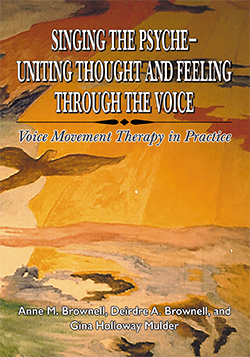
Cover painting of “Daybreak” provided by Anne M. Brownell
The title of the book, Singing the Psyche, was provided by Christine Isherwood.
Table of Contents
Foreword by Shaun McNiff
Preface: Taking It to the Floor
Chapter One: The Voice Unchained – Anne Brownell
Being Present: A Brief History and Introduction to the Work
Theory into Practice
The Core Principles of VMT
Chapter Two: Psychology and Soul Work
Introduction: The Role of Song in Psychotherapy – Anne Brownell.
VMT and Trauma: Upheaval, Alienation and Abuse.
The Hidden Voices of Cambodia – Trish Watts
VMT with the Displaced: Having a Voice When All Else Fails – Sophie Martin
Sylvie Sings Her Mouth to Life – Christine Isherwood
Meanwood: A Group Session – Carol Grimes
Mr. Handy: A Policeman in Trouble – Boniswa Kamba
Psychosis, Self-Harm and Addiction: Models of Engagement
Voice Studio: A Place to Let It Out – Helen White
Changing Lives: How I Use VMT in Mediation and Conflict – Gertruida Dowse
A Reflection on a Pilot Study with Young Women Who Self-Harm – Sophie Martin
Facilitating ChangeóBody, Mind and Soul: The Role of VMT in an Addictions Treatment Clinic –
Ben Van Rensburg
Sounding our Way to Wholeness: Linking the Metaphorical and Physical Voice with Women
Experiencing Eating Disorders – Irene Kessler
Chapter Three: Channels of the Voice–Affect and the Brain
Introduction: My Body, My Enemy – Deirdre Brownell
Individuals Experiencing Conditions Present from Birth
Dillan: Opening Up Channels of Communication with the Person Trapped Inside – Deirdre Brownell
Samuel: A Story of Healing Trauma with VMT – Sebastiana Black
Interviews with an Expressive Movement Educator, Three Young Men with Significant Physical and
Cognitive Delays, and Their Home Providers – Deirdre Brownell
Individuals Experiencing Conditions Brought on by Emotional or Physical Trauma
A Case of Selective Mutism and the Work of Tracy Starreveld
My Favorite Patient and How I Became the Singing Pastor: A Case Study of a Patient Recovering from
a Stroke – Anne Ross Maarman
Singing for Joy: Creating Community and Sustaining Function in a Choir with Parkinsonís Disease –
Carol Grimes
Chapter Four: Trusting Our Voice to Support Us in Times of Transition and Stress
Introduction – Gina Holloway Mulder
Subpersonalities and the Voice – Christine Isherwood
Swallowed by Grief, Saved by Voice – Trish Watts
Letting the Darkness Sing Itself: Working Creatively with the Shadow to Reveal Buried Rage –
Julia Norton
The Voice in Motherhood: How I Use VMTG to Support Women in Their Transitional Journey –
Anna Grabner
Soul Song Deep from the Bone: The Power of Story in VMT – Veronica Phillips
Chapter Five: Nurturing the Soul in the Performing Arts
Introduction – Gina Holloway Mulder
The Artist-Practitioner: How VMT Informed Me as a Singer, Songwriter and Performer – Mali Sastri
Singing the Breathing Body: Being Present to Your Own Performance – Melanie Harrold
Developing the Singerís Vocal Creativity – Lerina Van Rensburg.
Experiencing the Joy of Singing through the Container of Song – Eva Haidl
Voice as Archive in Devising Theatre – Gina Holloway Mulder
Chapter Six: Towards a Living Harmony: Voice Movement Therapy as an Instrument for Social Change in South Africa – with Boniswa Kamba, Nokubonga Mathole, and Gina Holloway Mulder
Introduction: Indaba
The Reality on the Ground
Where Our Work is Needed Most
Steps Toward Change
A Rainbow Nation Needs Songbirds
Conclusion: Going Forward: Growing and Grounding in Uncertain Times – Anne Brownell, Deirdre Brownell, and Gina Holloway Mulder
Glossary
Contributors
Name Index
Subject Index
Reviews
WHAT OTHERS ARE SAYING ABOUT THIS BOOK
From Shaun McNiff, Ph.D, author, art therapist, founder The Arts Intitute, Lesley University (Cambridge,MA, USA) from his Forward: Singing the Psyche elucidates, renews, and advances one of the most important traditions in art healing – spontaneous and full-bodied vocal expression. It is essential reading for those engaging the voice and models how to undertake in-depth and truly art-based exploration of a particular form of creative expression within the larger and interdependent community of art healing… Among the many admirable features of Singing the Psyche is the emphasis placed on studying the community of practice from which the work emanates. The authors describe their unique creations while affirming that we participate in a process larger than ourselves, accessible streams generated by so many more inside and outside the strain of a particular discipline.
From Susan Loman, MA, NCC, KMP Profiler, former Director Dance Movement Therapy Program, Dept. of Applied Psychology, Antioch New England Graduate School (Keene, NH, USA): This comprehensive volume will enhance therapists’, educators’, caregivers’, and parents’ understanding of the intricacies of using our voices for expression and communication. Through practical guidelines woven together with current interdisciplinary practices, theory and research, Anne Brownell and colleagues creatively decode the language of vocal expression. The importance of embodied expression through “voicedances” which contain the intense feelings within the structure of song ring out through the text. A wide array of vibrant clinical applications with many populations greatly illuminate the voice/movement therapy model. Over and over we learn how the voice and movement are the points of entry for relationships and intervention.
From Aftab Omer, PhD., President, Meridian University (Petaluma, CA, USA): In the beginning was the Voice. “I have a dream” resounded MLK from the Lincoln Memorial sixty years ago. The ritualized voice can move mountains. As powerful as music and language are in cultural evolution, it is the human voice that sustains connection and authenticity. This book is a true gift to global culture and has the potential to inspire a renaissance of interest and practice in the creative use of expressive voice and movement for therapy, coaching, cultural change and transformative learning. May this book travel far, like a song that heals and blesses, voicing the sacred commitments and compassionate inquiry of its passionate authors!
From Leonard Carr – Clinical Psychologist (Johannesburg, South Africa): Implicit in Voice Movement Therapy is the notion that wholeness and health are innate. Reclaiming what has been lost through life’s vicissitudes is the essence of healing, not repairing what is broken. We reclaim parts of ourselves that could not be experienced, fully owned, or connected to before our loss of innocence. VMT is about reclaiming, integrating, and embodying the self you were before you felt unsafe, inadequate, or unworthy.
From Jo Walters, MA, MFA University of California, Berkeley – Visual Artist and Writer (Fairhaven, MA, USA): As an artist and writer, I and my friends in many different disciplines are well acquainted with creative blocks in both art and life. When a friend suggested that I might be interested in reviewing a book on Voice Movement Therapy, I said, “Well, OK,” expecting to read an informative but unexciting tome. To my delight, this book clearly explains the basic principles of VMT in the first chapter, then presents five chapters of case studies by VMT practitioners who work with human situations world-wide and read like stories. It is a great read and so interesting that I called a musician friend and read one of the stories aloud over the phone!