
For professional practitioners in the human services to successfully fulfill their important job roles they must be highly motivated. In many human service agencies, however, practitioners encounter situations that can seriously impede their motivation to work diligently as well as reduce their enjoyment on the job. For example, working with limited resources, unrealistic caseloads, problematic supervision, or interfering events beyond an agency’s control (e.g., the COVID-19 pandemic) can all reduce practitioner motivation and work enjoyment. This book describes how human service practitioners can achieve and maintain self-motivation to be professionally productive and experience enjoyment on the job during both the best and worst of times. Self-motivation is presented in terms of practitioners actively using strategies developed through research and application in behavior analysis and therapy to promote their work productivity and enjoyment. Self-motivation strategies presented are likewise based on the specific advice of highly successful practitioners in the human services. Some strategies presented are robust in nature, in that they can be applied across varying situations to promote self-motivation and enhance overall quality of work life. Other strategies are more situation-specific, being tailored to overcoming particular obstacles to motivation that practitioners often face in human service agencies. The intent of this book is to provide practical information that effectively equips practitioners to be in control of their work motivation and thereby work consistently in a manner that is professionally productive and personally enjoyable.
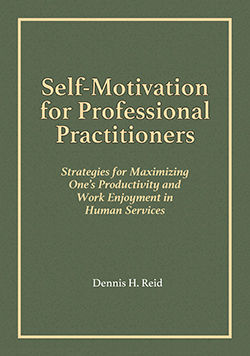
SELF-MOTIVATION FOR PROFESSIONAL PRACTITIONERS: Strategies for Maximizing One’s Productivity and Work Enjoyment in Human Services
$41.95
By Dennis H. Reid
Published 2022
238 pp., 7 x 10
Table of Contents
Preface
Chapter
Section I: Introduction to Self-Motivation
1. Self-Motivation: The Essence of Ensuring Quality of Work Life for Human Service Practitioners
2. Self-Motivation Defined for Practical Application
3. A Basic Self-Motivation Strategy for Wide-Scale Application
Section II: Singular Self-Motivation Strategies
4. Goal Setting
5. Self-Recording
6. Self-Reinforcement
Section III: Self-Motivation Strategies for Special Situations
7. Promoting Enjoyment During Unpleasant Work Situations
8. Working With Co-Workers in Ways That Support Practitioner Motivation
9. Promoting Self-Motivation When Working for A Problematic Supervisor
10. Promoting Self-Motivation When Working as A Supervisor
11. Promoting A Desirable Work-Life Balance
Selected Readings
Index
Reviews
Annotation
©2022 Ringgold Inc. Portland, OR (protoview.com)
Reid, a professional practitioner in the human services, explains how human service practitioners can achieve and maintain self-motivation to be professionally productive and experience enjoyment in their jobs, focusing on strategies developed through research and application. He describes the conceptualization of self-motivation for practical application and a three-step strategy consisting of establishing a goal, engaging in the work needed to achieve it, and reinforcing attainment of the goal; self-motivation strategies like goal setting, self-recording, and self-reinforcement; and strategies for specific situations, including promoting enjoyment during unpleasant work situations, working with co-workers to support motivation, promoting self-motivation when working for a difficult supervisor, strategies when working as a supervisor, and establishing a work-life balance that supports self-motivation. Chapters include case illustrations.